Monday, 17 February 2020

February 17 Land ho!

Cape Adare with its curlicue of cloud

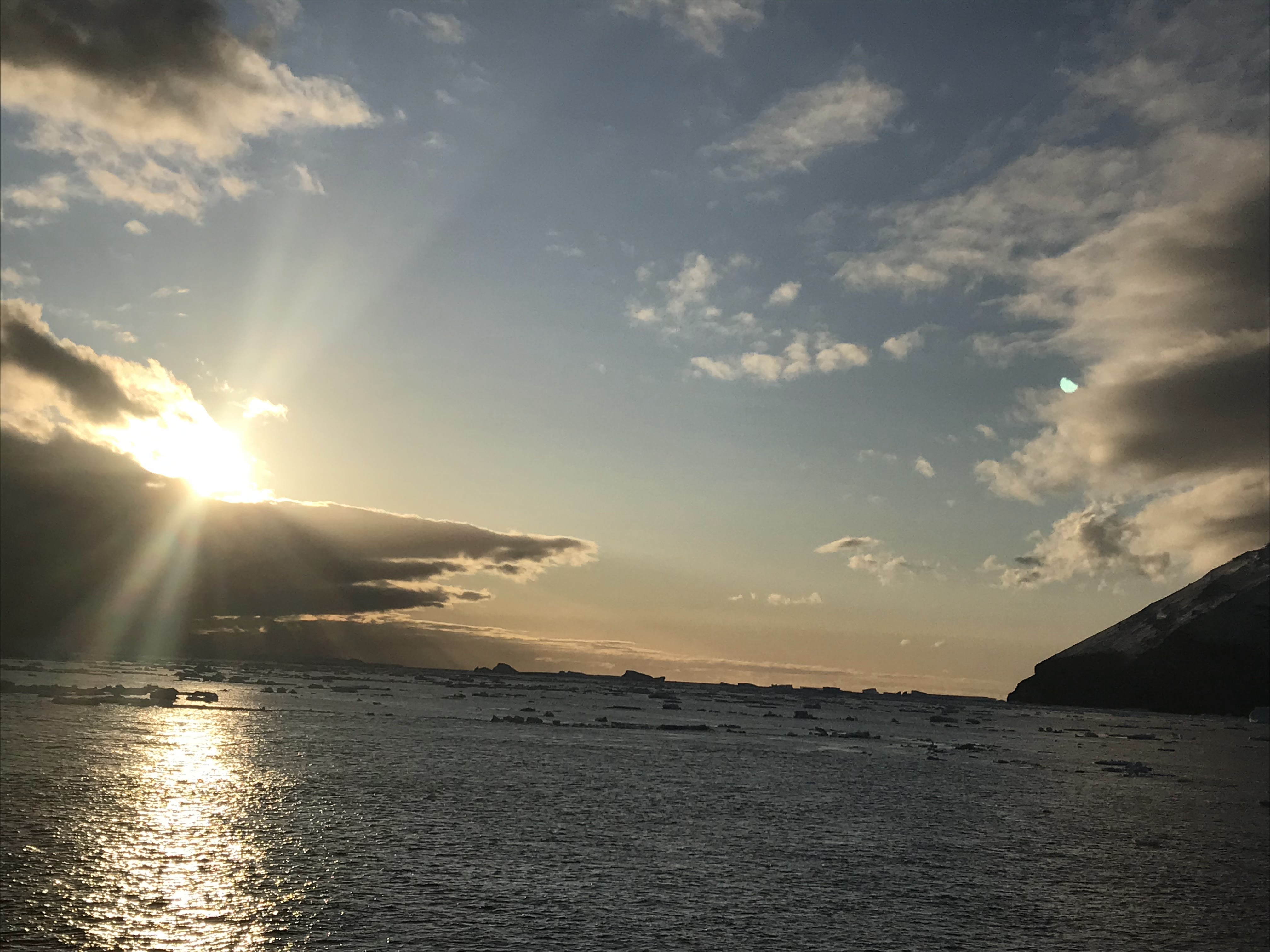
A wake-up call at 4:00am the next day brought us bleary-eyed up to the Bridge to see land after five days of an empty horizon tossed on an enormous and stormy sea - well, almost stormy. We were all rather sleep-deprived and exhausted but we had arrived at the bottom of the world, Antarctica. Callooh callay!!! We were approaching Cape Adare, the western headland of the Ross Sea. And there it stood, a stark dark shoulder of land looming large against a spectacular backdrop formed by the Transantarctic Mountain Range (which divides Antarctica into East and West). One could imagine how this sight must have struck wonder and awe into those early explorers! The early morning sky was painted in delicate pastels to the east - it was glorious!

The scene was absolutely breathtaking surrounded as we were by gigantic, monolithic icebergs, humongous glistening frozen chunks the size of city blocks calved off the Ross Ice Shelf and mega glaciers. The sun was very low in the sky but it was a dawn! and it cast a soft apricot glow on sky-rise icebergs and turned the sea and clouds to dark slatey blue. (Many icebergs were smudged pink which was not due to the early morning rosy glow, but rosy penguin poo. The particular species of krill the penguins eat is pink-red hence the colour.)  The scene was so overwhelming it brought tears to our eyes.
The morning dawned glorious and gentle as we slid slowly into Robertson’s Bay 

Biiigg chunks of ice which are completely grounded on the sea floor.

The rosy pink smudges on this, and other, iceberg were painted by Adele Penguins 
With bergy bits, chunks of ice, banging against the sides of our ship, we slid slowly into Robertson’s Bay hoping to land on the wide beach at the entrance to the bay. Here cute Adelie Penguins were fanned out in chattering, muttering clusters with a few giant Elephant Seals plopped in between. Some of the penguins swam out from shore, porpoising towards the ship in a delightful happy greeting - it was quite beautiful. The wildlife is fearless and so welcoming - and it was very humbling.

Amongst the bickering happy mass of penguins (and penguin poo!), stood the remains of Borchgrevink’s Hut, an overwintering shelter for his, the first, expedition to the Antarctic continent in 1899. Astonishingly, it is still there well over 100 years later. Whilst the history of Antarctic exploration during the early 1900s, the Heroic Age of Exploration, is quite riveting, Lindsay and I were primarily there for the wildlife and to experience a tiny bit of this mysterious continent. This is, of course, what brought those heroic men south all those decades ago - that and the mad dash to be first to reach the South Pole.

Remnant sea ice packed in along the shore that morning prevented us landing any zodiacs. So eventually, after we had taken our fill of the splendour cupped in the amphitheatre of mountains and the smorgasbord of exotic wildlife, we headed around the Cape and on southward into the Ross Sea. We were fairly drained by the end of the day. A culmination of the excitement of reaching Antarctica, dashing back and forth between decks, bow to stern and aloft to the Bridge many times throughout the day - not to mention lack of sleep after many very rough days at sea - it was a wonder-filled day and put us in the right frame of mind for what was yet to come.

The Transantarctic Mountains rise to over 4 Km and stretch more than 3000 km across the continent. 
It was freezing cold but we were deliriously happy

Sunday, 16 February 2020

February 16 Crossing the Antarctic Circle!

 Now we were really heading into the cold! At 3:00 am six days after we set sail from Bluff, and while we were adrift on dreams of icebergs and penguins, we crossed the Antarctic Circle 66 34 S; 168 53 E.  With the exception of a small part of the Antarctic Peninsula, Antarctica lies entirely within the Antarctic Circle - we were getting close! 

A gentle, quiet morning greeted us. 
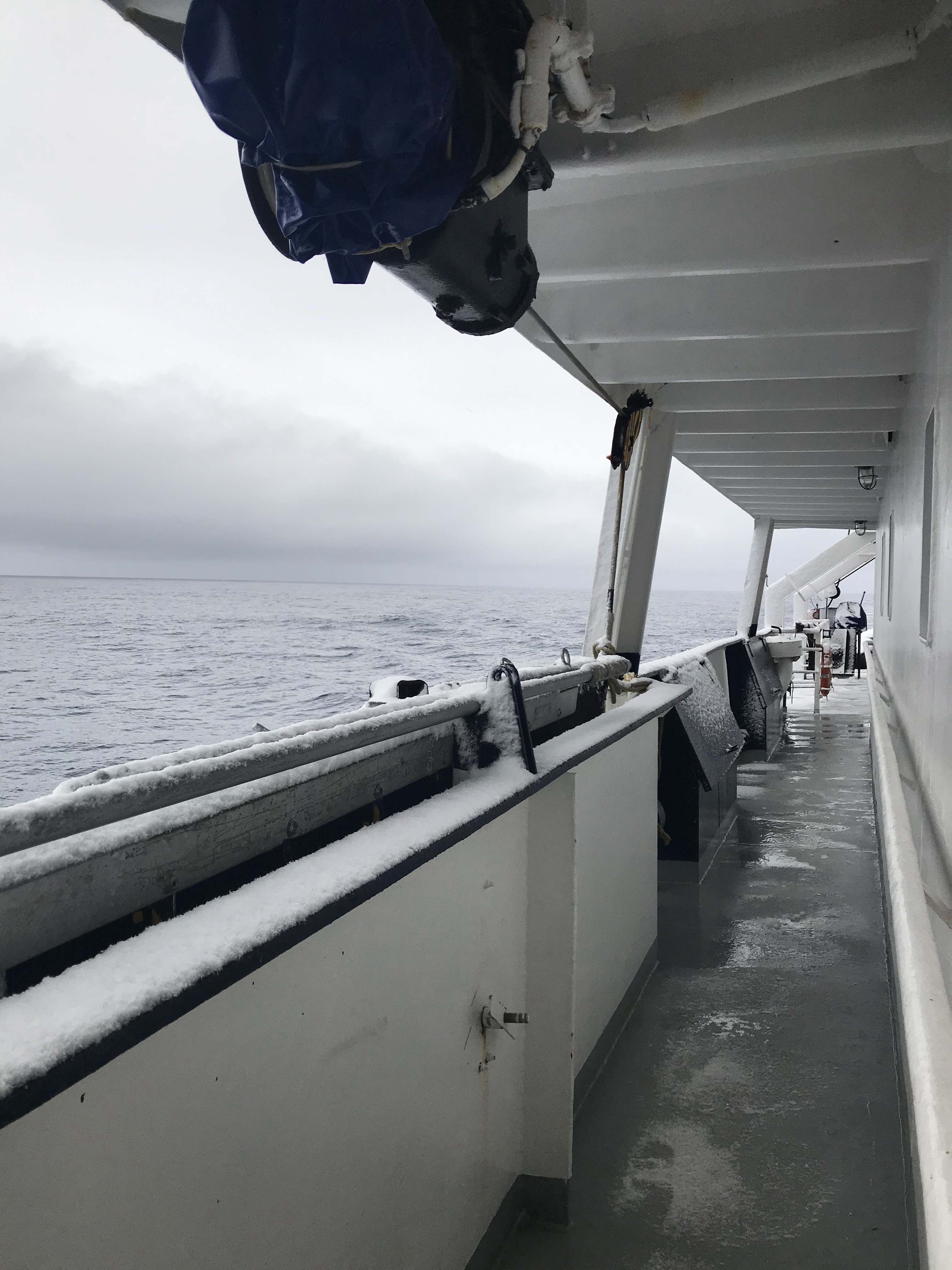
We awoke that auspicious morning to a soft silent world with a light blanket of snow over the ship sparkling in the sunlight. Absolutely beautiful! We all felt a mounting fizz of excitement with every passing hour as we came ever closer to sighting land. And the day only got better and better. You have to be out there on the ocean to really appreciate just how vast and powerful the Southern Ocean is.
For an hour or so, a small pod of Humpback Whales played ‘ring a rosy’ with us, as ship and whales circled each other in a delightful dance. They may have been feeding close to the surface but it was obvious that they were putting on a performance for us - diving under and swimming flank-to-flank with our ship, rolling over and surfacing so close to the ship that we could see every barnacle. Curiosity from both sides - sea and ship.  We were all completely mesmerised.

After this rather thrilling dance as man and beast circled and inspected each other, we were all buzzing. And the mood of the ship stepped up another notch to a heightened sense of excitement and expectation after a briefing on Cape Adare where we hoped to make our first Antarctic landing early the next morning.

Wednesday, 12 February 2020

February 12 Are we there yet? Water, water everywhere


The sea spray tossed up from the bow froze on our window.

We were all at sea for the next five days. It was pretty rough and not surprisingly as we travelled further and further south it got colder and colder. Some days it was best to stay in bed rather than risk falling over as the ship tossed and bucked through towering waves and frighteningly deep troughs that threatened to swallow our little ship.  Needless to say, I didn't get a lot of photos during that time. Most people suffered with a bit of seasickness, but blessed anti-seasickness patches helped a lot. Given the remoteness of our journey, in addition to the usual lifeboat drill, we had a demonstration of the suits we would have to don in the event of an abandon-ship alert. Struggling into an immersion suit looked like a challenge but in the temperatures we were experiencing, they would be essential. On a previous voyage, they had to abandon ship for some hours - I don’t recall the reason but it was rather sobering to contemplate. These were designed to protect you from the icy waters of the Southern Ocean.  The thought of that happening put the wind up many of us. 


This is Samuel our expedition leader demonstrating how to get into those immersion suits.

As we rode the waves south, and when the seas allowed us to venture down to the lecture room, we had a number of lectures. During this intervening time, I 'penned' a few bits of polar trivia to go on with. Some people confuse the Arctic and the Antarctic - or perhaps it is simply the names they confuse because they sound alike. The locations are certainly very different in so many ways. The clearest difference between the two polar areas is that the Arctic is sea surrounded by land whereas the Antarctic is land surrounded by sea. The word Arctic comes from the Greek word arktikos, ‘near the Bear, northern’. The name refers to either one or other of the bear constellations prominent in the northern sky. Antarctica comes from the Greek word antarktiké meaning ‘opposite to the north’. I believe the Antarctic deserves its own name, distinct and indicative of the huge land mass that it is, rather than being simply antipodal to the Arctic. 

Unlike the Arctic which is a region with a relatively sparse landmass, Antarctica covers 14 million square km (Australia is 6.7 million square km).  If we want to talk about the ‘land down under’, this truly is it. In contrast to the Arctic, in Antarctica there is little vegetation other than moss, lichen, some fungi and algae, most of which are phytoplankton. Yet once there was lush life on the landmass we now call Antarctica. It was once warm and forested. Shackleton found coal seams as well as fossilised wood and leaves. And since then, the growing list of plant fossil finds in Antarctica has been dated to species living between 40 and 100 million years ago when Antarctica was pretty much in the same location, relative to the equator, as it is today. I know we love our frozen polar regions but what most of us don't realise is that for the majority of Earth’s history, the planet has been hotter than it is now. In fact, hotter periods make up a good part of the past 2.5 billion years and are called Greenhouse Earth. They can last hundreds of millions of years, with CO2 levels 10–20 times higher than today, with no ice anywhere on the planet. The Earth swings from Icehouse to Greenhouse. During Greenhouse periods, the Earth actually explodes with life but that's a whole other story which is endlessly fascinating - to me! Getting back to this story ...... Antarctica is also colder than the Arctic because it is covered by an ice sheet and has been for the last 15 million years. Today that ice sheet is almost 3 km thick and it continues to grow. The sea ice at the North Pole is only 1-3m thick and is shrinking. 
And then there’s the wildlife - why aren’t there penguins in the Arctic or polar bears in the Antarctic? Distance and proximity - amongst other factors. Terrestrial animals in Antarctica are predominantly insects, invertebrates that are able to survive the extreme cold because they have glycerol in their body fluids - anti-freeze. On the other hand, there are oodles of marine animals and birds. Incidentally, penguins are said to have been named such because of their resemblance to the great auks of the far north. In Welsh, pen - head and gywn - white. Or so the story goes. 

Tuesday, 11 February 2020

February 11 Campbell Island

Lying like stepping-stones to the Antarctic continent are the little-known Subantarctic Islands. Weather permitting, we were to visit some of those remote island - The Snares, Auckland, Macquarie and Campbell Islands on our way to and from Antarctica. The original plans had been to visit many of these islands on our way south but with COVID spreading its claws across land and oceans alike, Macquarie Island said 2 weeks isolation before you can visit us. So with some last minute and clever rejigging, we changed our route and headed for Campbell Island to visit Macquarie Island and the orher islands on the way back from Antarctica. 

What a delight after almost 2 days from when we cast off from Bluff and after sailing through pretty rough seas, we arrived at Campbell Island - and quiet waters. Tranquility!  It was a wonderful respite. 

Formed by volcanic eruptions, Campbell Island is the southernmost island on the New Zealand continental landmass. It’s home to the Southern Royal Albatross as well as other bird species but importantly for me. were its mega herb fields. Unfortunately, most plants I came across were not in full bloom when we visited but I was told there were bigger fields of these beauties on the high plateau. Sadly, I wasn’t up to the climb wearing gumboots 2-3 sizes too big - add to that a dose of vertigo from the rocking and rolling of the ship over the previous couple of days. However, we were to visit 3 more Subantarctic Islands later in the voyage, so I had my fingers crossed to see more flowers.  I found other fascinating planrs on the lower slopes.  One the Pleurophyllum criniferum has very unusual flowers - dark purple disk florets which have no petals. The leaves are huge, measuring up to 1m long. The stems are snowy white. Quite stunning.My book was coming in handy! I came across other interesting species including many Acaena minor which is endemic to Campbell and Auckland Islands (another of the Subantarctic Islands). Another plant I was able to identify was Bulbinella sp. One could get quite absorbed and easily missed reboarding the ship.

The island is covered in a beautiful array of grasses and ferns as well as Rata forests and mega herbs.
Top R+L - Pleurophyllum criniferum a strange giant perennial daisy. 
Bottom R - Acaena minor and bottom L an example of Bulbinella sp.
Although Lindsay and I didn’t climb to the top of the island to visit the albatross breeding colony, we went exploring through a dwarf Rata thicket and stumble upon a wee baby Hookers Sea Lion and its huge mum just dozing. We didn’t dwell long for fear of stressing mum and bub - and especially because mum was massive and probably could have outrun us - and she had one eye on us!  This thicket was a long way from the water and quite high on a cliff but the sea lions manage to haul themselves up here to birth and suckle their young. We saw sea lions much further inland later in the voyage. 
The Rata thicket where mum and baby Hooker Sea Lion were resting

Saturday, 8 February 2020

February 9 Curio Bay

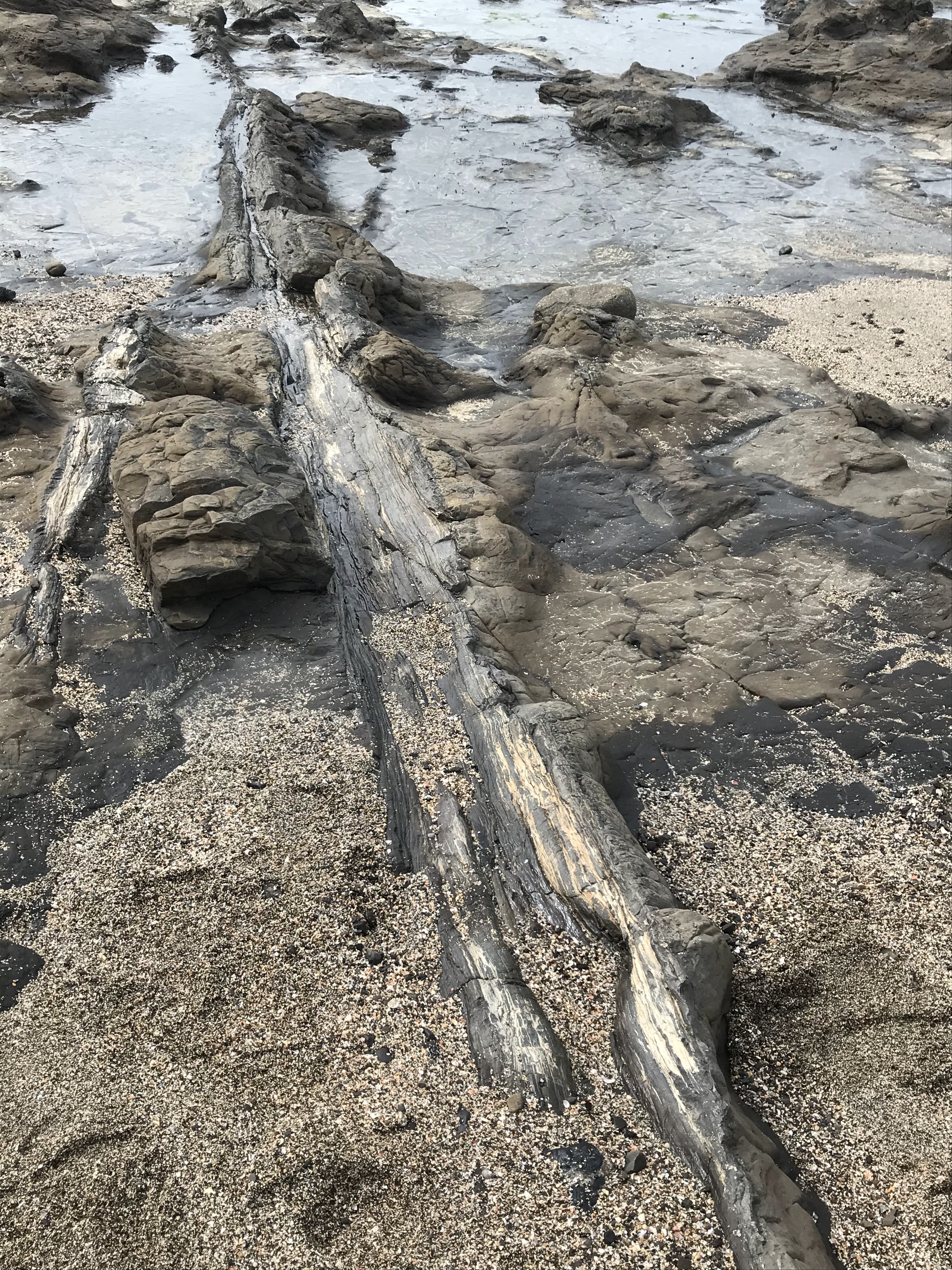
And we did see that amazing petrified forest. It was quite marvellous wandering over the rocks with the sea crashing in and over what was once a forest of tall and small trees alike. I could have spent many hours just picking my way over the rocks. Wandering back from that rocky platform, we entered a living forest of New Zealand native plants. 
Ancient petrified giants littered the rocks 
I wandered across the rocks, stepping over the remains of a once mighty forest. 

I'm not sure what this might have once been - a flower, fern, twig? but I saw a number of strange shapes embedded and forming part of the rocky shore.
Anisotome latifolia (L); Hebe elliptica (R). It can be white through to mauve and is also found in the Falkland Islands and South America. Gondwana links abound.

These red pines formed part of a patch of living forest near the petrified forest. Interesting contrast. 
Then it was back to the bus and on to meet our ship at the Port of Bluff - next stop somewhere in the Southern Ocean.

Heading out to sea, it was blowing a gale and the Pilot boat was almost swamped a number of times. 

February 8 Exciting prospects!

 I am pretty excited about the prospect of visiting the Subantarctic islands because that’s where those stunning mega herbs grow. Right now, we’re in Invercargill lapping up the local fare and quite enjoying being in New Zealand. Last night, I had the most delicious seafood chowder chock-a-block with all kinds of seafood and topped with local green-lipped mussels and giant prawns. Lindsay had succulent roast lamb. It tasted like the lamb of old and was accompanied by loads of roast veggies. A good way to start our adventure and tonight we have another dinner to meet the expedition team and our fellow passengers. Tomorrow, on our way to the Port of Bluff to board the Spirit of Enderby and to start our journey to the frozen south, we visit an ancient geological site, a 170-million-year-old petrified forest - what a way to begin this exciting expedition!

Our wee ship - the Spirit of Enderby which took us to Far East Russia almost 4 years ago
All aboard!  You know the story about the little tug that could? Well this is the mighty little ship that could and has done so many times over the years! It is quite impressive - as is the Russian crew. It will take us through massive seas, through sea ice and .....

Friday, 7 February 2020

February 7 Invercargill

And we were away, scudding through the air in a prop plane bound for Invercargill where we would meet up with the rest of the passengers and crew of this exciting expedition. We flew over braided rivers of the Canterbury plains, formed by glacial outwash gravels during ice ages.

 And yes we were in a prop plane - you know you’re flying!
I was of course interested in the vegetation of New Zealand's Subantarctic Islands and contacted the NZ Department of Conservation to find out where I could get a decent reference book.  They promised to get one to me! And lo and behold my book about the flora of these islands was waiting for me when we checked in at the hotel yesterday. I became quite excited flicking through the pages at strange otherworldly plants of the Subantarctic Islands.
Glorious colours of New Zealand Flax


A wonderful refernece book on the flora of the Subantactic Islands
Many of you know that I tend to be a wee bit focussed, but it catches me a little by surprise when people seem to know nothing at all about Antarctica, particular southerners. The young NZ woman sitting next to me on the plane on our flight to New Zealand asked what the accommodation options were like in Antarctica! Well .... apart from scientific research stations, there aren’t any! There are no permanent residents in Antarctica, neither has there ever been any indigenous people: no native Antarcticans. Since the land mass over the South Pole, Gondwana, spilt up, there have been no land bridges to Antarctica for over 35 million years and that’s before humans evolved, according to the fossil records at least! 
She was puzzled about what we might do on such a trip .... hmm? What could I say to her that would make any real sense to her? Cruising around in zodiacs, landing on totally deserted, desolate beaches, visiting the most southern sea in the world, following whales .....
We will be visiting a few of the Subantarctic Islands, including Macquarie Island, on our way to and from the Ross sea. We have many days at sea to the Antarctic and between islands, with one stretch of 5 days - it’s a looong way, almost 3000 Km, from Bluff NZ to the entrance to the Ross Sea, Cape Adare. 

Updates still to come

 I'm still in the process of rebuilding this blog about our trip to Antarctica in 2020. Please be patient and stay tuned.